
Time Spent Floating
The Workbench Dispatch: 021

Hi. I’d like to say sorry for the absence but truthfully I’m not. I’ve spent the last handful of weeks more or less completely offline, both literally and figuratively. Disconnected and detached. Tucked away from the world as a sort of silent hermit. Working on remaining jewelry orders for 2025, reading all I could, and writing down notes and thoughts at about the same pace. It’s been a period of tremendous rumination all in all. Thinking about what the future may bring and what we can possibly do, about regrets I may hold for the path I’ve taken the last few years, about the bleak state of affairs we all find ourselves smothered in today. I couldn’t tell you exactly what the final straw was that made me finally delete “the apps” and seriously debate cathartically whipping my phone into the inky depths of the East River, but something in me just broke. I can’t say it was surprising or unexpected given, you know, quite literally everything every second of the day now seeming hellbent on breaking your spirit in some way. I felt completely disgusted by the unstable scaffolding I found myself propped on top of after the last 7 years, scorned and jaded by the hollow, synthetic events and relationships it brought me to. I just couldn’t take it anymore, whatever it is. The broken floodgates of AI pollution and online degeneracy, the horrific decline of mental faculties of the population, the useless scoffing cynicism perfuming nearly every statement now from people wanting to make themselves feel better for swimming in the same pool of shit we all find ourselves stuck in, the gradual acceptance that we’re all destined for illness and catastrophe, it’s all absolutely devastating to one’s mental wellbeing to be constantly assaulted by that. We find ourselves in contemptuous, disgusting times, in situations so broken that even the “back in my day we had it bad” crowds are finally willing to admit it. It’s discouraging, it’s terrifying, it’s debilitating, and most of all, it’s fucking nauseating. I was overwhelmed by this nausea, as it creeped in and penetrated nearly every aspect of my life. Relationships, physical and digital presence, ambition, things that once provided solace now all felt bitter. I couldn’t seem to escape it anywhere. The things I once cared for and about suddenly appeared alien and strange to me. I felt completely alone, surrounded by screaming belligerent virtual neighbors. I just didn’t care at all anymore. I needed a break, if only for a little while, otherwise I felt like I’d fully be subsumed by whatever this existential crisis was. I needed to step away from everything.
So that’s what I did. I spent the last ~2 months floating. I was (and if I’m being candid probably still am) in the throes of a nasty depressive spiral, surfing the crest of something not very pleasant to think about. It certainly doesn’t help that we find ourselves fully entrenched in a particularly harsh winter early on. Bitter cold, grey skies, and general discouragement all around. Hard, cracked, rough hands cringing against the sickly smooth polyester of puffer jackets or shoved inside gloves that remove all tactility, gusts of wind like shards of glass numbing your cheeks and nose, the winter is a period of great unfeeling. A time of insulation and layers of defense, both physically in the outfits we wear, and mentally in the familiar ruts we create for ourselves. Things feel frigid, lifeless, frozen in stasis in every sense of those words. Everyone is sick, proximity and closeness and intimacy act as sources of revulsion or alarm than tried and true human comforts. Simultaneously, in a similar vein, phone use is itself also inherently without feeling. Everything by design is flat, virtual, synthetic, on one plane of experience. There are no smells or textures or depth or physical feedback to truly ground it in reality, just the sensation of finger on smooth, flat glass. Having that make up so much of our days now, combined with the physical unfeeling of the colder months filling in the real world, just leads to a significant dulling of the senses within a 24 hour period. We begin to exist as just brains without bodies around this time of year, experiencing only by watching. Everything’s overpriced, nothing seems fun, the risk versus reward ratio of trying to “go out” has never felt lower. So in turn, maybe as an experiment, maybe as some kind of psychological coping mechanism, I blocked it all out. I isolated myself from pretty much everything outside of the grocery store and the post office (and the movie theater). I stayed silent, actively trying to absorb as much as I could and afford myself some peace and time to really think. Floating just outside of it all like a kind of sensory deprivation tank. A search for solace in solitude. Maybe it was a form of voluntary exile, some type of self-shaming that felt like what I deserved for some unknown offense. I couldn’t tell you. Even now, it feels odd to use the past tense as I still find myself riding that threshold.
To be honest, it’s been pretty tough trying to wrangle my thoughts from leaning into this spiral the last few weeks and put them into a cohesive typical structure like I have in the past. I wound up writing a lot more than I anticipated. Time kind of gets away from you when you’re out here just floating. Sometimes all you have is the migraine inducing thump tuh thump tuh thump of your upstairs neighbor’s booming EDM through the floorboards to remind you that it’s a Friday night. Although I got some thoroughly enjoyed thinking done, about a range of subjects, hammering thoughts and ideas as they arrive into my notes app in no particular order isn’t really optimized for organization. But maybe that’s the point. With how schizophrenic and disconnected everything seems to be these days, maybe something more loose is the better delivery method. I know it’s tough to find the time to read these days, especially on your phone, so instead of the usual long form write-up, consider this a collection of 3 blog posts, organized thematically from chunks of the notes app as best I could. A kind of charcuterie board of trains of thought. Read them all in one go, or spread them out and save them for next time you want to replace your doomscroll. There’s more on the way. As usual, thank you for reading. It really means the world to me.
-ms
⫘⫘⫘⫘⫘⫘⫘⫘⫘⫘⫘⫘⫘⫘⫘⫘⫘⫘⫘
The Nausea of Ambition
The last few weeks, I’ve found myself plunged into a full on existential crisis and depressive episode. It felt sudden, but I know it wasn’t. It was a long time coming, having been built up gradually over the course of the last few years. I was hit with a culmination of full on apathy towards nearly everything I thought I cared about. To me, the last 7 years of doing this, whatever you want to call it, felt like I had wasted my time. I looked around and didn’t really see anything that felt real to show for the effort, the anguish, the labor I put into it all. I’d seen (and still see) my ideas, images, methodology, business model, style, even my bio stolen or ripped off or co-opted without remorse, picked apart and floating in the digital abyss completely detached from me with no way of getting them back or getting compensation, because that’s how social media works. I experienced someone I was led to believe was my friend use me for free game and clout and tangential connections to build their “personal brand” just to turn around and pull the ladder up in a narcissistic flurry of self aggrandizing, because that’s how social media works. I still feel kept at a perpetual, eternal arm’s length on the outside of things, only existing when I can offer someone something, because that’s how social media works. Where were the things I thought this “project” would accomplish? I found myself entirely embarrassed by the ambition I once thought of as my guiding principle. The belief that I, that we, could actually do something, do it differently, make some type of real forward change not just to the way things are done, but to ourselves in the process. I tried, fully and sincerely. What once drove me incessantly like a battery in my back now just felt like a smoldering coal in my chest. I felt like I had failed that mission and found myself at the start of a closed loop once again. Sometimes it’s hard not to think that these hallucinogenic last few years were some type of world trying me on like a jacket, hating the fit and discarding me, or really relegating me to the back of the closet. Still there in case I’m ever “needed”, but not part of anything serious, not breaking through any type of significant threshold. Clearly the ideas aren’t the problem, so it has to be something else. Maybe the “problem” is just how social media works.


Don’t get me wrong, I still find endless amounts of gratitude and fulfillment from the things I was (and am) able to make, both for other people and myself. For every engagement ring or graduation present or just an impulse buy of a tee shirt, it solidified that I did something. That there were real human beings on the other side of that cold, unfeeling screen that sought me of all people out and trusted me. The fact that we are in such dire times makes the passion projects feel all the more important. The systems around us are crumbling in real time, so again doing things in an indie way feel like the path to take. If everything is going to be shitty and unreliable, why not try to do it in a fulfilling way? That support, frankly, is the only thing still keeping my head above water right now. It’s maybe the only thing in this superficial, synthetic world I’ve found myself in that actually is real. At bottom, it’s evidence of human connection. Beautiful reminders that I didn’t completely make the wrong choice. A way of defying the corporatized, homogenized degradation of what was once an enchanting new tool for connecting people by using it for that exact original purpose. In our modern era where every physical and digital space feels increasingly taxed or exploited, the transient spaces in between those spaces (email threads or DMs for custom ordering jewelry for example) act as a place of refuge to still find that direct connection that has been stripped away. It feels like over these last few years, that original mission statement of connection has vanished completely unless you will it to be yourself.
So really what is this apathy I feel now? This sensation that the things I once regarded as important just don’t stimulate or maybe reward me in the same way? Is it that I’ve outgrown them? Why does that previous ambition make me nauseous? That spark that invigorated me before now feels like the bite of a static shock. It’s certainly not for a lack of inspiration. Have I really become that jaded by the whole thing? Maybe it’s as simple as being a victim of the times like everyone else. It’s a tricky spot when an economic recession coincides with a cultural one, and that seems to be where we find ourselves now. Nothing, from music to design to film to nightlife to art to how it’s all talked about, is safe from the exploitative maw of commodification now, the “stagflation” and “enshittification” of it all, people included. The superficiality and narcissism and vanity of the worlds I found and still unfortunately find myself immersed in serve as burning reminders that at the end of the day, I can attribute whatever deeper meaning or artistic merit to the things and mediums I care for, but a majority of people don’t, especially now. When it comes down to it, the people in superficial spaces with superficial interests have no obligation to want more than that. Maybe certain people in their shilled, exploitative, hollow, narcissistic presentation just make some shit look so bad you want nothing to do with it anymore. It becomes so unappealing that you reject it wholesale, sacrificing something you once loved or cared about in the process. I find a quote from the Coen brothers’ 2007 classic No Country For Old Men constantly ringing in my head these last few weeks,
“If the rule you followed brought you to this, of what use was the rule?”
If all this ambition and care for the things I held close did was deliver me to people and to worlds I felt completely alienated or exploited by, is this really the best way to go about things anymore?
Around a decade plus ago, it truly felt like social media was promised to be a “new world”. A place to do things differently, against traditional gatekeepers, and maybe progress forward using it, manipulating it in creative ways that utilized the ethereal, long-reaching nature of it. Not everyone thought about it like that at the time, but some of us knew what we had. The artifacts of this thinking are still trapped in amber when you look back at that time. Even I was on record preaching that it’s “easier to get 1,000 followers to see your work than to get 1,000 people in a gallery”, and that this new exciting path presented far much more potential for innovation if we just used it right. However, that “new world” quickly just became the world. The line between virtual and actual began to disintegrate as the two bled into one another. It got “figured out” for what it was, not just by the users, but by those that wanted control over it, and over time it was regulated and manipulated into oblivion. You couldn’t play by your own rules anymore. The platform was no longer a level plot of ground for you to experiment with, it was now taxed by spam and shitty ads and algorithmic sorting to maximize profit for the company as much as it could, even at the expense of the userbase.
As I’ve said before, somewhere along the 21st century there was a major shift between bringing real world standards online (emails formatted like letters with traditional greetings and sign-offs, websites and pages thought of as spaces to decorate, physical textures or trompe l’oeil emphasized in graphic design, etc) to bringing online standards into real life. The internet and social media were no longer ancillary tools for supporting the primary real world, but instead became the dictators of it. The source of all information and news and opinions and trends in a completely homogenized, monocultural product that in turn began to influence the world our bodies occupied. The postmodern heterogeneity it supposedly presented in its early years was eventually transformed (for profit incentive, for propaganda, for any number of reasons) into the algorithmic homogenized echo chamber we know it as now. I’ve already written about this at length before so I’ll just put that here for the sake of time. Maybe it was always destined to end up this way, given the nature of it at its core, of people at theirs. When thinking about this acute depression and apathy I’ve been feeling recently though, it’s impossible to ignore the glaring factor of just how much these once somewhat viable platforms, the ones I established my livelihood through, have changed within the last few years and become all but unusable.
One thing I noticed in my time away from social media is I really didn’t miss much, if anything. The unending swell of sensationalized news and hot takes and cyclical cynical opinions completely passed me by for around 8+ weeks, and had nothing to show for it. The synthesized FOMO that was meant to keep people scrolling was completely absent. Try a break for yourself and see what I mean. A trap that I and I think a lot of people fell into, specifically in the last 2 years of social and social media degradation, was focusing so much on my output that I never realized the input I was getting was absolutely fucking useless. The average user contributes far more than they are now receiving from the apps, both in terms of quality, effort, and care. Weirdly enough what I felt finally checking the TLs after such an absence was a kind of empty, twisted vindication. Ideas or thoughts for the future or feelings that I had that I assumed others would went completely unexpressed. It was the usual endless cycle of self-aggrandizing and nostalgia masturbation and baseless morality flexing and “I am VERY smart” posturing and all the rest, never having crept even an inch forward towards something new. Frankly, the familiar hollowness I returned to was horrifying. In a personal period of feeling truly unheard and unseen, it was a dizzying reminder that unfortunately if you don’t say something, it might not ever be said in this current ecosystem. The labor of keeping things moving forward can’t be reliably dependent on the crowds online anymore, it’s your responsibility. For better and for much, much worse.
There’s no properly describing the sensations of dread and desolation that come with puttering around the now decayed TLs like walking through a bombed out shopping mall. Thinking about it conjures images of wandering around post-catastrophe Pripyat in that classic CoD 4 mission All Ghillie’d Up: “50,000 people used to live in this city, now it’s a ghost town.” Signs of what was once a lively place now haunted. Any remaining stragglers voicing their anxieties or reaching out for some shred of similarity or common ground are met with plagues of blue checked shills or bots repeating the same cycle of phrases they have for the past 24 months, forever stuck in discursive amber. Others simply use cheap reactions as bait for likes or clout or attention. Clogging the system with detritus we’ve already ignored or digested before. Without venturing too far into hyperbole, there is an un-ignorable sensation of lifelessness online right now, in every meaning of the word. In an algorithm based digital space, there is no longer a guarantee that what comes across your feed was done so because real people decided to make it happen. In our modern AI world, humanity is viewed as a liability, not an asset. As such, it feels like every decision now on these platforms is meant to strip away just a little more of actual humanity to be replaced by something synthetic and something owned by someone else. Real humans replaced by bots or AI, the heaviness of death permeating every piece of news we encounter, the inhumane lolcow culture that has taken a stranglehold of online behavior and the way people talk, it’s hard not to feel like everything when you open your phone now is directing you towards some form of suicide, be it physical or spiritual. I myself am not immune to these feelings. It’s harsh but I feel that if I left it unsaid it would continue to fester and marinate in my brain and grow in strength. The reason I needed to exorcise that statement was because in doing so it only makes me realize that succumbing to that, above all else, gives this system exactly what it wants. Another number in the statistics that get filed away never to be thought of again. All part of the machine. There is no way to break or change or defy that machine if you feed yourself to it. Nihilism is exactly what this thing we find ourselves in now wants.
This lifelessness carries over into how we present ourselves online now. We have witnessed firsthand the final stages and effects of turning ourselves into human kitsch, sanding ourselves down with tropes and pastiche and recycling the same over and over in order to appease the algorithmic machine gods until we’re all mannequins with caricatures stapled to our faces. Yes we may have acquired some notoriety or even monetary gain from this experiment, but it’s a hollow thesis ultimately built on nothing meant for progression, just endlessly looping in a state of self-exploitation for the currency of attention. The decline of social media wasn’t an overnight thing as we’ve seen, it was a gradual degradation. A transformation into a useless half-object that serves as a now defaced monument to the optimistic promise of the 2010s, with much more history hidden in it than would appear if you were to look at it in its current state. The (now in hindsight completely false) archetype of the young tech “punks” wanting to break out of the way things are done has been replaced by the new old guard. The feudal landlords monopolizing and taxing digital space, running them into the ground for profit. Observed now, it would be easy to mistake social media platforms for an old casino left without maintenance, to be assumed that it never did anything good for anyone. Maybe that assumption would be true. It’s a shame because it really felt like at one point, we really had something nice going.
A question I’ve been wondering a lot recently, in relation to my own effort towards these platforms that at one point felt like a new way forward is, does social media as it exists now even deserve good content, or art, or other types of output with actual effort behind it? Or has it all been spoiled. Have the people gorged themselves too much on free game, free art, free ideas, free recommendations, free opinions, free pieces of real people while still demanding more at an even higher volume and concentration? Most people forget 90% of the things they look at online or who they saw deliver it to them, but they still want the dancing for peanuts to continue uninterrupted? With the lack of care social media seems to have now for the remaining things that make it semi-decent, maybe it deserves the garbage nothing content and destructive selfish narcissists 24/7. Stupidity and glib detached cruelty and ignorance are addictions, ones we’ve built up obscene tolerance for and dependence on over the last few years. It feels good to most people to act entirely selfishly, to hide in pseudo-anonymity and purge venom onto strangers, to hedonistically consume constantly for that indulgence in a microsecond of dopamine without a second thought. I would argue that complete saturation of that might be the way for people to finally overdose on it, causing a rejection of it, but I know even that is wishful thinking, as we’ve seen that if left to its own devices without any protest or rebellion or pushback, the lowest common denominator will always dominate in our current culture. “Trash begets Trash”.
Maybe that sting of ambition I feel is coping with a world I couldn’t truly see coming or was ill-prepared for or admittedly too hopeful to accept. One that I’m not happy being a part of or contributing to anymore. It becomes harder and harder to delude myself into playing along as if things are still the same as before, ignoring the exploitation that has shifted from the background to the foreground. “It’s just the way things are” gets exhausting to hear after the 100th time it’s parroted back to you. When do we get our say in the way things are? When are we allowed to say No? What are you supposed to do when reminders of the present just make you nauseous, this deep dissatisfaction infects nearly everything, but at the same time everything remains stagnant all the same? When you feel completely without power or say in the course of things anymore? I can’t blame people for hiding in the past as a reaction to this, because I’m a victim of the same thing. Burying, insulating ourselves in what was maybe not simply as a distraction, but looking for answers of when it all went left. Piecing apart how we got here and maybe finding a new alternate path that branches from there out of desperation. Mark Fisher described our obsession with nostalgia as not just a mourning for the past, but also for the potential futures that never materialized. The pain of an old wound. We see this constantly on every side of the political spectrum trying to will their own respective rose-tinted signifiers of the past into reanimation. The vignettes we all had in our heads about where we’d all be right now that one day turned to radio static without us noticing. Now we’re here. Looking in books, in movies, in music, in art, in other people, investigating for tiny pieces of anything to assemble into something to help ourselves, help us, out of this. But like Slim Charles famously said on The Wire:
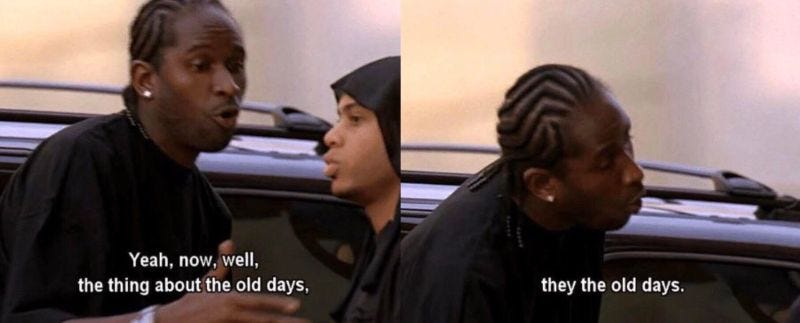
The last few years certainly have felt like a slow mourning of a world we once knew. Playing back the greatest hits as we face oblivion. “Man remember when…” is all we seem to have left, or at least what we’ve been given. Nearly everyone in my generation (those who actually care at least) is complaining about staleness and recession on a grand scale, trying to scrape by and make a living picking at or commenting on the carrion of the last remnants of “culture”, while the subsequent generations following us are being primed to be fed directly into the fire. We need better fast, it’s do or die. The future is vanishing in front of us in real time. Only undercut and underscored by multiple ongoing unceasing relentless genocides, climate disaster looming and closing in, and no change on the immediate horizon. It’s hard not to fall into depression and nihilism and feelings of defeat, something that I’m clearly not above myself. I belong to a generation that grew up with fantastic expectations for what’s possible just to have every single one of them be ripped away and torn up with glee in service of not much in particular. A generation grieving with our own mortality decades in advance, told that it’s not going to get better. One told to follow their dreams only to be scolded for doing so, ending up in a digital crowd of thousands applying to data-mining scams or ghost positions on job sites. Everything seems to have led us to a dead end we had no preparation for, and somehow it’s still our fault. How are we supposed to react? How are we supposed to feel? Maybe keeping this in mind is a way to go, using that attitude for art’s sake.
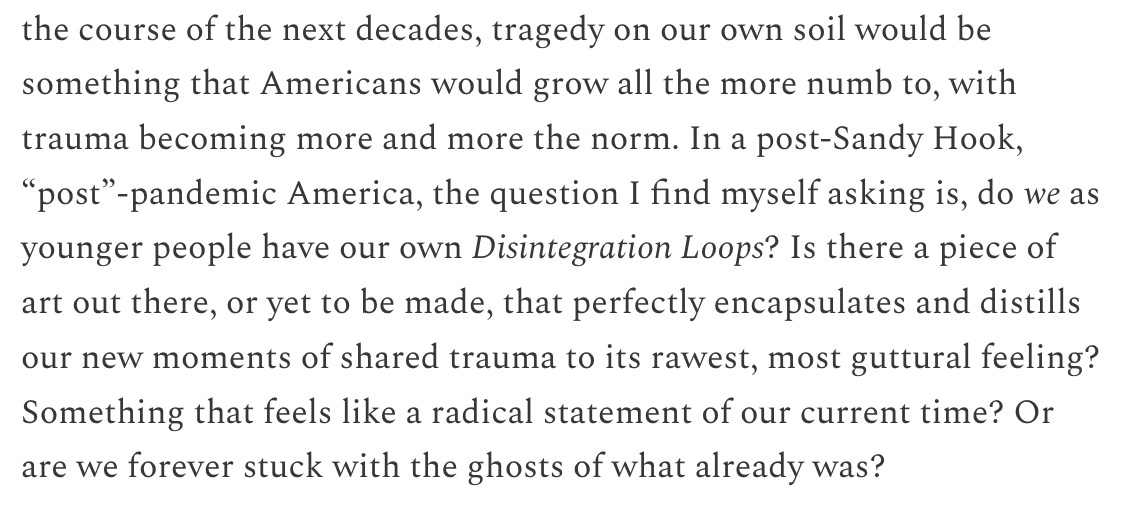
When I think about why I do what I do, I don’t want fame, or notoriety, or being the center of attention (getting paid for the value of ideas would be nice but hey, one thing at a time), I just desperately want to reach the world I imagined when I was younger. The one I was sold was possible. I want to live through those hazy, warmly lit, softly soundtracked vignettes I still feel so viscerally in my chest that they impact me like a sledgehammer. The ones that re-emerge when I listen to songs from high school that remind me of what I used to think the timeline or quality or ambition of life would be. Right now, what’s available in the world (or maybe just the world we’ve found ourselves in in this moment) isn’t that. Far from it actually. Right now it’s $16 cocktails and hacking uncovered coughs and a plateaued dumb culture and vacant stares past your eyes from people so corporate and blank at soulless events it makes you wonder what you’re even doing there. What you’re even doing here. What any of this is for. Is this the reward?
We are currently in a fog, grieving and coping with the fact we may never get to reach those visions we had in our head because that version of the world is gone. Slipping through our fingers in real time. Often, I and I’d assume many others feel an instinctive recoil against certain things that feel “too 2025”, a type of overwhelming postmodernism-poisoning in your stomach. An almost anachronistic feeling of being out of place in the present moment. How did we get here? This nausea is referred to in several different ways colloquially now (think calling things “spiritually Israeli/Dubai”), but the feeling is all the same. I think the causes of this feeling can be traced back to that same hauntology Fisher theorized. It is a terrifying realization that the “real world” as we once knew it is vanishing before we had a chance to really experience our go of it. Like we didn’t get a fair shot. I’m not talking about the right wing nostalgia-bait catchphrase of “The world you grew up in no longer exists”, I mean that the very idea of what’s considered the “real world” has mutated completely. Through sickness, through digitization and radicalization, through everything. It’s simply not the same anymore. The digital world for many now is considered their primary one, with the physical world just providing transit in between screens. Much like the famous phrase “God is dead” was more about society living and behaving as if God were dead with no objective morality, if enough people behave as if the physical world is secondary to the digital one, as they’re doing now, the experience of everyday life would reflect that as fact. That’s where we currently find ourselves. But now, as these feelings of distaste and nausea persist, getting more intense and searing, there has to be something we can do about it. Not burying our heads in cyclical nostalgic trends and “bringing things back”, but rather bringing things forward. Wrestling control of the wheel back in order to at least get our shot at the world as we once knew it (or want to know it) can be experienced.
We’ve arrived at a crucial impasse. We can’t ignore this rancid revulsion we feel towards the modern day and postmodern aesthetics any longer or continue to passively watch hoping things will get better without our own intervention. We see grifters succeeding in their scams daily, with newer and newer ways of posturing over the gullible and their good faith. We feel the twisting discomfort of the dominant post-NFT and AI visual language, of the big red boots’ dual infantilization and cynicism, of the outdated manchild iconography of the Cybertruck, of contextless TikTok simulacra fashion. These are our defining tentpoles of this decade so far and we have the power to reject them and demand better for our time here to be defined by. The power of the consumer is unmatched in today’s world, for better and often much worse, so the work needs to begin there. I believe it is easier to change things on the ground level where we have a voice versus at the top where we clearly do not. We can remember how bad these things were moving forward instead of looking back 15 years from now waxing poetic about how good we had it. We don’t have it good now. We know and feel this wholeheartedly. Despite the imagined things sent in to divide or subcategorize us, we are all in the same boat. There is too much of a shared, collective conscious feeling, be it admitted or lying dormant, to not use it for something. What’s seen as a dismal and barren flattened plane can also be a blank canvas with which to do whatever we want. We just have to commit to it. We have to be for real this time. To draw a line and set a higher standard not just for ourselves as consumers, but us as people, us as a collective world with lives deserving of value. Like Albert Camus wrote in his monumental essay The Rebel:
“In absurdist experience suffering is individual. But from the moment that a movement of rebellion begins, suffering is seen as a collective experience - as the experience of everyone. Therefore the first step for a mind overwhelmed by the strangeness of things is to realize that this feeling of strangeness is shared with all men and that the entire human race suffers from the division between itself and the rest of the world. The unhappiness experienced by a single man becomes collective unhappiness. In our daily trials, rebellion plays the same role as does the ‘cogito’ in the category of thought: it is the first clue. But this clue lures the individual from his solitude. Rebellion is the common ground on which every man bases his first values. I rebel - therefore we exist.”
I’m starting to think that maybe the way forward isn’t to abandon those snapshots of what we imagined the future to be, because doing so might plunge us further into hopelessness. What might be a more proactive solution is to reinvigorate and strengthen our own cultural imagination, so we might be able to figure out how we can not just reach our new version of those goals, but more importantly create the conditions that give them room to exist naturally, not synthetically as we try to do now. For every person chiming in with the at this point readymade catchphrase opinion how we need to “Return to ___” (be it Reagan era conservatism, mid-2000s sickly plastic graphic design trends, 2010s hypebeast fashion, or anything else), or for every person blindly and gluttonously accepting everything contemporary with no critical thinking or analysis for the sake of better uninterrupted consumption, there is in fact room for more than those binary options. Instead of constantly ruminating on what was or what is, there is power in trying to imagine what could be, and taking action and steps toward that, whatever they may be. Our own personal steps, shared common steps, a set of values that go beyond just accepting what is or was forced on you. We’ve already seen the effects of the experiment that is sacrificing values for the sake of capital or connections, it lead us here. People love to romanticize indie sleaze and hipsterism and all the rest, but are unwilling or maybe unable to conceive what the 2025 version of those things would even look like. Again, that’s because those things can’t ever truly exist in our current times, for any number of reasons. What can potentially exist however, is our new version of them. I’m not talking about simply just taking what we can get and convincing ourselves it’s something that it’s not either. I mean really working towards something new we can truly call our own. Speaking from my own experiences from the last few months, sometimes the hardest part is simply imagining what that future where you’re happy even looks like anymore, but if that’s not labor that feels worth the struggle, I don’t know what is. It’s not an easy solution, and it’s one that requires a tremendous group participation, not just a scattering of concerned thinkers like it appears to be now. It will take strenuous effort and yes even some speed bumps and friction and failure, but it’s necessary. We have to change the way we view and encounter things, digest them, react to them, put them out into the world. All of us.
Maybe that’s what this inward spiral has been for me. The painful stages of grief for a future that is fading in the rearview mirror. But the last stage of grief is acceptance. What can be seen as the end of something can just as easily be considered the beginning of something else. As for that nausea towards ambition I’ve been feeling, maybe it’s just a symptom of the times. Maybe the systems set in place right now are designed to try and kill your ambition, and succumbing to that is just falling victim to the way things are. Things have to change, and we can make them do so. It’s not an easy job whatsoever, especially as we know it will take way too long for others to catch up as usual, and that desperate feeling of waiting will be arduous, I won’t sit here and lie to you. I don’t know how soon such a thing could reasonably even happen, but what I do know deep down is that it’s not impossible. It can’t be, for all of our sake.
⫘⫘⫘⫘⫘⫘⫘⫘⫘⫘⫘⫘⫘⫘⫘⫘⫘⫘⫘
It’s the Falling in Love
“Americans…are forever searching for love in forms it never takes, in places it can never be. It must have something to do with the vanished frontier.” - Kurt Vonnegut, Cat’s Cradle
I think I’m finally ready to fall in love (again). I know in the era of countless Substack writers blogging and pontificating about dating and situationships and all the rest, the idea of love is something that is far from under-discussed. You really can’t seem to go anywhere online without encountering some type of observation or advice or hack relating to the inclement ecosystem of emotion we find ourselves caught in today, let alone the amount of generated discourse on the matter. Like most things in the time of postmodern capitalism and social media, love can feel like an industry. As someone in the engagement ring business I can tell you firsthand, love can be considered quite the racket in the minds of people. In our late stage world, just like everything else, it’s often seen as another interest to finesse or exploit to your will, or something you can win at. It’s gamified through dating apps, used as a cheap marketing trick to sell you things, and turned into yet another signifier that people decorate themselves with (We all happen to be real lovers coincidentally). The reason I say I’m just now ready to fall in love again isn’t because I’m finally getting over a breakup or because I’m lonely or any other reason people justify their entrance into the dating pit, but because it’s serious business to fall in love, and it takes a lot. Again I feel the need to clarify, I’m not talking about getting into a relationship or even getting married. As we’ve seen time and time again, those things and love are sometimes completely unrelated. People get into commitments for all sorts of reasons: anxiety, boredom, societal pressure, security, narcissism, reassurance, a need for companionship, and all the rest. Love on the other hand demands a different level of gravity. Love is chemical. Love is philosophical.
In one of his quintessential works of existentialist writing Being and Nothingness, Jean-Paul Sartre lays out several principles and theories relating to our own lived perspectives of the Self and the Body that I think are crucial for fully understanding what love is on a richer level. One of the most notable ideas he presented in this work is of facticity versus transcendence. Facticity can be thought of as the rigid, unchanging things that make you you, while transcendence is our capability, drive, and most importantly freedom to break, go past, transcend those things. Our facticity is rooted in our past, circumstances and events that have supposedly made us, while our transcendence lives in the future, the things we can or may or will do to change what we can consider ourselves as. The tension between those two exists in the present where they both constantly meet and clash. Our facticity that makes us up and our transcendence past it have an equal amount of influence on each other in both directions, and both require an understanding of what you are and what you are not yet. For Sartre, to deny either of these is an egregious act of mauvaise foi, Bad Faith.
Love can be seen as an ultimate test of our facticity and transcendence. Love is irrational, something that takes you out of yourself and shakes up your world before you even know what happened. It grabs what you thought of as you and your life and throttles them down an entirely new path that you never could have seen coming. It makes you behave (seemingly) outside of yourself while simultaneously giving you a greater understanding of what your Self even is. You know it when you feel it, even without words. Not only that a new thumbprint has been placed on your brain, but that the door of your world has been thrown open to reveal just how wide your scope can go, how vast the landscape outside what you thought of as you is. You know that there’s no closing that door once it’s revealed, usually for better, sometimes for worse. Time and time again, love will give you a clear understanding of who you’ve existed as up until this point and the drive to redefine that all at once. It makes you rebuild an updated, bespoke new you, now with room for two.
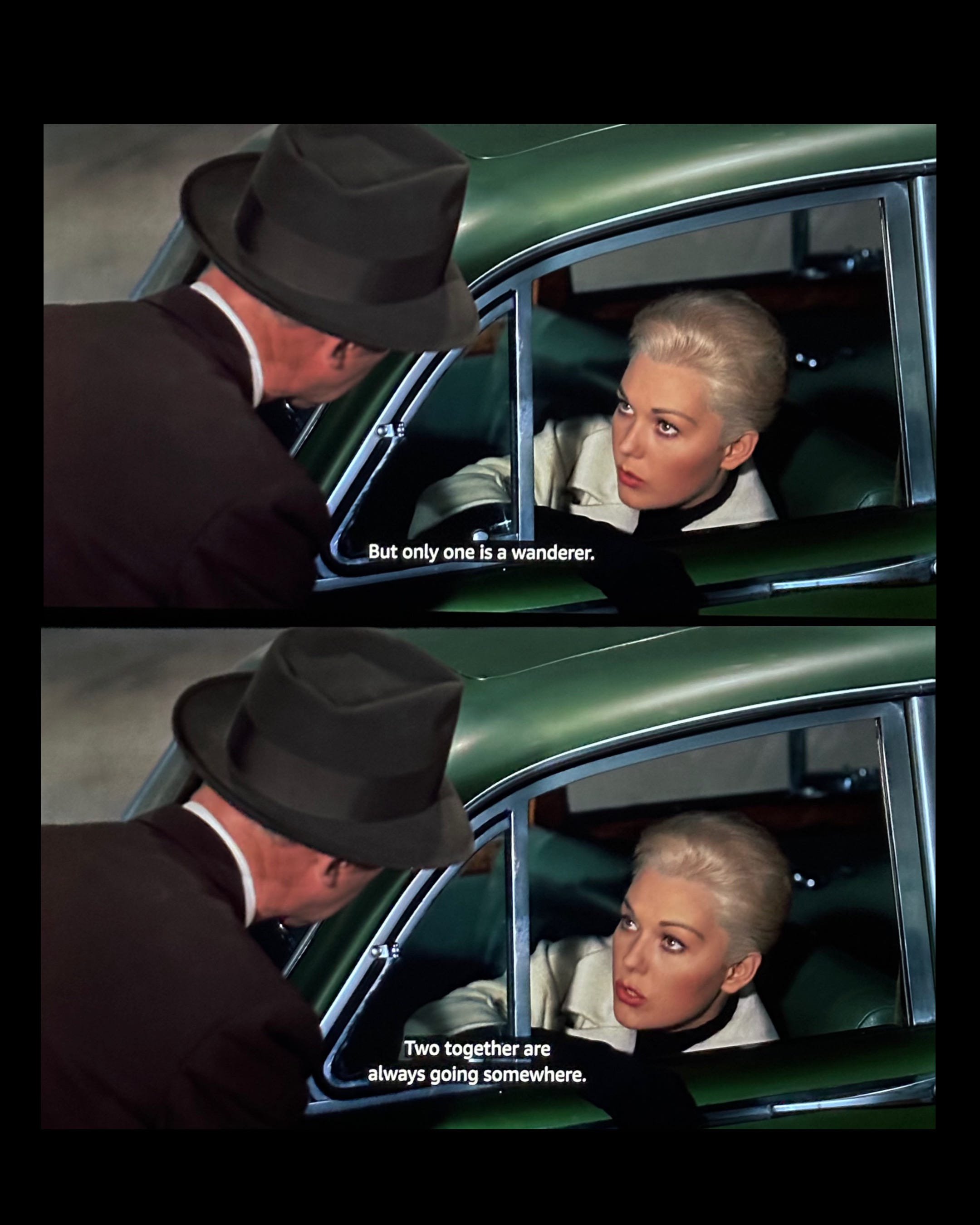
However in recent years, we’ve seen this idea of transcendence shrink in the public consciousness. The social media age is the era of algorithmic hyper-curation, the Personal Brand, the online echo chamber, all things that ignore the Other and serve to reinforce a rigid, unchanging facticity. Now more than ever in a personal data based world, your identity is a tool that defines you. You’re encouraged to construct yourself as and remain a seamless finished product, only concerned with the past and the immediate present, never the future. The idea of changing oneself or becoming loses priority to the act of being. Paradoxically though, through things like microtrends, short form media, and the all-around ephemeral quality of how we consume now, we also have a weaker understanding of who we even are. Yet we remain as rigid and stubborn as if we did. Our changes become lateral. We are all at once stuck in our ways, and unaware of what they truly are. Less defined by ourselves or others, and more by our content diets. Who am I really getting to know, you or the pages you follow?
I believe that this societally reinforced disconnect between our facticity and our transcendence has been one of the major root causes of a lot of the tumult surrounding romance and love within the last decade. Dating is viewed as disposable now not just because of the throwaway quantitative data based nature of dating apps against a qualitative phenomenon like love, but also because we as people don’t feel fleshed out as dynamic, full subjects but rather unchanging objects. We see each other as easy archetypical projections based around consumption habits and content and virtual social dynamics, never as actual living, growing people. More people now are completely rejecting dating apps because they know that this is all they lead to, just another platform to hyper-curate a static, fixed profile and outsource one’s self esteem to an algorithm. Relatedly, just as often, we are also detached from sincerity behind screens as a coping mechanism to the invasive, surveilling, panoptic feeling of social media now, which blurs the idea of the Self or the Other even further into abstraction. We are scared to reveal what we really are because we’ve all been scorned by past traumas, so we build a substitute in our place. An emotional crash test dummy. When we rarely truly interact with each other, but only with our respective projections of ourselves, it really isn’t surprising why we find ourselves witnessing a culture of ghosting, of disposable half-effort “situationships”, and of epidemic level loneliness. We’re all disconnected.
“True” love seems to escape us all now more than ever. Is it because there is some naturally occurring resource called Love that there’s suddenly less of now like fossil fuel, or is it because we are doing everything we can to stifle the conditions necessary for it to manifest? A notorious truism you see frequently online now when talking about relationships is “if they wanted to, they would.” which speaks to the growing dearth of etiquette and chivalry found in the batch of people in the current dating pool. While there is a tremendous amount of truth to that, it ignores an important factor in the equation. The question of if we collectively are doing enough on our end to inspire that “want” in each other. Within the last decade, have people changed because the behavior of dating changed, or has the behavior of dating changed because people changed? It seems to be both in a self-perpetuating cycle. Similar to the reasons stated above, it shouldn’t be controversial to say that we find a pretty fucking boring batch of people to work with when it comes to finding a partner right now. Now more than ever, regardless of gender or sexual orientation, it feels like dating has been reduced to a series of data points, a checklist of icks or demands that one must match perfectly like a job application. Additionally, we’ve also seen a massive rise in an ass-backwards regressive preschool vision of gender essentialism under our neoconservative era of culture. Girls like flowers and babies and fawns and feelings while boys like war and video games and drinking freaking beer. Boys don’t cry. Sensitivity and emotional introspection is relegated to women, while men are understood to be simply performative in their impression of them (“the dichotomy is crazy”). We choose a caricature of what “brand” of masculinity or femininity we want to embody from a very limited list with very little imagination outside of them. It’s almost as if our current generation is trying to synthesize the idealized “stability” of some bygone era by constructing a shoddy bricolage imitation of select elements from it. As a result, we all wind up strictly conforming to these imitations without ever questioning breaking out of them. This all only further reinforces that emphasis on one’s facticity and ignores the idea of transcendence past it. It’s why our generation feels so slow to grow and change, because societally, it is incredibly discouraged to do so. Change, within the last decade or so, has been shown to lead to things only getting worse. It creates a completely sterile, barren environment that makes actual love that much harder to form. Something as transformative and fluid as love is not really compatible with the static, fixed nature of identity, let alone our vaporous, undefined version of it in our current moment. Most people now seem to be dating for the person they are or were, and not the person they could be.
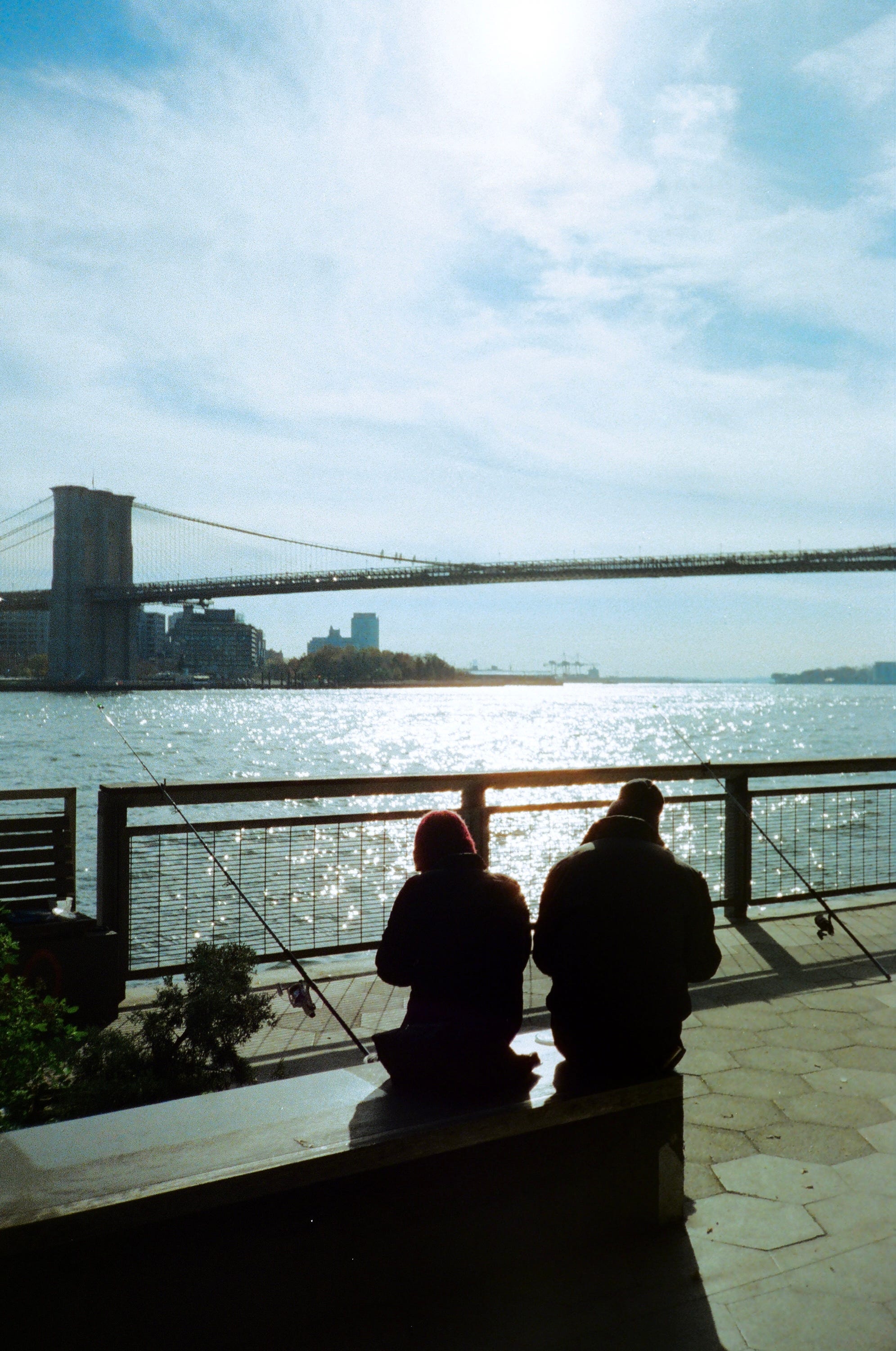
As you may know, one of my favorite ideas of philosophical writing comes from Deleuze and Guattari’s theory of machines and flows, a perspective I believe in the power of so much I made a bike jersey about it with my friend. The abridged version, for the sake of use here, is that everything can be considered a machine interfacing with and being actualized by other machines. A person and a bike, an artist and a movement, a society and a city, and so on. This actualization comes in a state of flow as part of a process in motion. Identity or facticity for a machine only truly exists in the moment it becomes a part of that flow of another machine (the moment a person uses the pedals of a bike, etc). Identity isn’t some predetermined thing you one day discover in full, but rather something fully dynamic that breathes and changes in the context of what it interfaces with. A creation of the difference between everything you are in a moment, and everything you’re not. In the example they give of a wasp and an orchid, by becoming a crucial part of the orchid’s flow of its pollination cycle, the wasp is actualized with identity by essentially becoming part of the orchid itself, and vice versa. That identity can change outside of that flow, but in that moment, the wasp and the orchid can no longer be thought of as singular, isolated monads, but as an entirely new subject, a new machine in motion. Love is an actualization through flows and interactions no different than this example. Love as a process is a machine in itself, but it is also a flow, a transfer of emotion, energy, identity, and more, all in motion, never truly fixed in place. It is an act of constantly becoming instead of being. When you truly fall in love, when you relinquish yourself to it, you become actualized with an identity not just by the other person, but by your relation to that person in that flow of love. You become part of each other, through each other.
In our modern data based dating world, one that encourages static facticity and detached identity, it’s no surprise that we seem to be lacking the connection we need more than ever. Machines in a vacuum, like the increasingly virtualized and isolating plane we find ourselves in, can never fully be actualized. A prevailing attitude of stark, clinical, sterilized individualism, of overly-categorizing narcissism, of identity that’s set in the stone of the internet, is inherently against the dynamic, complicated, friction-filled realm of love. An overwhelming amount of commercials and advertising these days appeal to this very same state we’ve been lulled into. Thesis statements that shake out to nothing more than “Goddd this is too harddd, can’t someone just do it for meeee, I want a freaking burrito and I want it NOW.” This same attitude can be found in and applied to countless different aspects of modern life, including and especially romance and love. It’s hard not to feel like we’re all trapped in porn world now. Synthetic, simulated versions of once social experiences (be it sex or romance, food, movies, music, art, conversation (via AI), or really anything) delivered directly to you whenever and wherever on demand. The textured human factor of these sensations that once defined them and the pleasure attached to them has become so removed from the end product that these phenomena now exist in the minds of people as completely different entities to what we have always known them as. As a result, we see generationally, culturally, they are treated as such. Love is thought of as just another pleasure product to be doordashed to you, and the person that delivers it is just a means to an end. It’s no wonder why there is a near-ubiquitous feeling of disconnect in our modern world now. The tools we were once given years ago that were meant to supposedly bring us together all over the world only made us all grow more distant from each other despite (maybe because of) our digital proximity. Love, or more broadly connection, has become one of the greatest insecurities of our time. Do we have real connection? Do we have enough connection? Our interactions, our chances at truly connecting with each other, are all mediated and separated by a smooth, unfeeling glass screen. We’re on a sidewalk on a cold night, looking into windows for small glimpses of each others’ lives from a distance.
“Yet high over the city our line of yellow windows must have contributed their share of human secrecy to the casual watcher in the darkening streets, and I was him too, looking up and wondering. I was within and without, simultaneously enchanted and repelled by the inexhaustible variety of life.” - F. Scott Fitzgerald, The Great Gatsby
I’m ready to fall in love because I’m ready to be changed. You have to be ready to invite that change in for it to occur. I’m not interested in who is the right match for who I am now, but for who I will be, whatever that may look like, and whoever it may manifest through. It’s not just imagining a future for yourself, but a recontextualization of what The Future even is. What you will be compelled to offer for the sake of actualization through this greater machine. Love is an enchanting sensation, one that makes you give away what you thought of as your facticity without even a second thought and lets you transcend it in ways you might not have ever imagined. When what’s presented in front of you is nothing but unchallenging plug and play forms of commodified love, what is the thing that’s meant to sweep you off your feet and make you want to change? A common error I and many others have fallen into in our checklist based romantic world is thinking based around that facticity, only considering what you get out of love, not what you contribute to the system of love itself. A great partnership isn’t just a list of things you can offer each other, but what you inspire one another to do. It transforms you from receiver of experience to producer. Falling in love inspires a drive in you to challenge everything you think you know about yourself and the world, making you realize that you’re now a part of a much greater flow. A process much greater than simply the sum of its parts. Confronting this challenging of facticity, this view of Self as subject in relation to another subject, is not an easy task by any means, especially in our modern world. As time goes on, more wires of our inner understanding of ourselves get crossed and tangled together, and having to rewire that system can seem like an impossible undertaking. I can speak from experience, in the past I probably have stared down this very feeling but was too young or too naive or maybe just too selfish to let it take me full on. Maybe I robbed myself of learning this stuff earlier, but you live and you learn. That’s why love is so scary and so serious. The irrational nature of it stands directly in the face of all we know in our data based world to be logical and sound. In a time of apathy and irony poisoning, love can’t be anything but sincere and full of effort, and compels you to do the same as if there was no other option but to be. This relinquishing of control is what makes it so beautiful and so painful all at once. But it feels like now more than ever, it’s exactly what we need. <3
⫘⫘⫘⫘⫘⫘⫘⫘⫘⫘⫘⫘⫘⫘⫘⫘⫘⫘⫘
It’s Okay to Not Be Okay
One of the biggest defining traits of the 2020s has been the leftover attitudes from the 2010s contrasting and clashing with the realities of our current era. As time creeps onward, the distance between then and now grows exponentially, not just temporally, but societally and psychologically. What could arguably be defined as a decade of optimism or at least looking towards the future has been replaced by one where an uneasy foreboding feeling of finality dominates every decision. Climate disaster, mass illness, war crimes day in and day out, a removal of humanity from populations both physical and digital that only grow more selfish and cruel. The once “punk” promise of tech optimism has mutated into scattered monopolies siphoning the life out of the new world they established. A combination of less critical thinking and less articulation of the moment have created a culture that is nearly impossible to define, to understand, to make real or tangible. Culture now is simply reaction to moments instead of the moments themselves, which pass by out of our reach and control. Solely reactions to an unending slew of horrific news and products and commodities and opinions to opinions to opinions. It’s no wonder why it all blends together now, it’s all the same plane, a haze of floating postmodern unreality. A culture of detached identity and anonymous cruelty. A generation of people that only know what culture once was, basing their movements and decisions off of an outdated map with no lighthouse in sight, gambling with their future. Many of these leftover attitudes from the before times still find themselves dictating behavior now, even while now feeling completely out of place contextually in our times of cultural, economic, and behavioral recession. Maybe it’s a coping mechanism, shutting out the reality of the world we find ourselves in hoping that if they pretend everything is still okay, it will be.
One of the last lingering traces of this is in a portion of people on social media still propping it up for what we used to know it as. We still see remnants of the 2010s “influencer era” of Instagram stunting and “Thank you The Can”, of people still workshopping tired “bits” on Twitter hoping to still be screenshot into some type of canon of Good Posting. Now that we’re deep in the 2020s, surrounded by a userbase that only gets more polluted by cretins, grifters, and straight up bots, these ways of using the internet feel further and further antiquated. There’s nobody to flex on anymore. Nobody fucking cares. One of the strongest leftover vestiges of this old era that has carried over much further than the rest however, is the attitude of “Well I’M doing good.”
This statement in just a few short words may be the keystone of the last 2 decades. It perfectly captures the growing selfishness and narcissism and self-centered thinking, while is also indicative of that leftover attitude of 2010s internet stunting. We have become so used to the highlight reel nature of social media, of curating an image of nothing wrong ever happening to you (because you are divinely chosen, you are the main character, as opposed to everyone else), that we may have lost the ability to think outside of that. We are bound by the constraints of not upsetting the algorithm or making waves because we have been so trained to maintain this facade that WE are good. Well if we were all good like we claimed to be, we wouldn’t have so many people agreeing how hard things suck now wouldn’t we. It’s an attitude that we can clearly see not just online, but as the driving force in the real world as well. We watched an uncaring, non-discriminatory illness wipe out millions of real, living people in just a matter of months, and just as fast manipulated into just another figment of the Other’s imagination. We’ve seen economic turmoil put countless people into uncertain financial purgatory, hundreds of thousands of citizens without jobs left to float in the churning pot of bureaucracy that just become statistics in the minds of The Haves. People sincerely believe that they are the center of the universe, and that as long as they’re happy and thriving, even in a failing system, things can’t possibly be bad. I know firsthand, because I’ve really talked to people like this. They’re really out there still. I think there is a great spiritual delusion present that we must unlearn if we want to begin to fix things. The first step is just admitting that things aren’t going so well.
In recent years, I find myself thinking a lot about the 1970s (just look at how I dress). A decade defined by the highest political corruption being put center stage, an overseas political quagmire that felt like a desperate lashing out of a floundering government, and internal conflict that destabilized the nation, all right after what felt like a series of major steps towards progress. It’s really hard not to compare that turbulent period of time to now. The 1970s were a time defined by the paranoia and anxiety of a nation that felt gripped by uncertainty about what the future will bring. As Jimmy Carter put it,
“The symptoms of this crisis of the American spirit are all around us. For the first time in the history of our country a majority of our people believe that the next five years will be worse than the past five years.”
This observation that was once criticized as too pessimistic now feels basic in comparison. Looking back to that time, I think the biggest thing we can learn from it is this: the power of speaking up. The art from that period of time gave a voice to the rejection of the way things were in spectacular fashion. The bleakness and angst and fury of the present moment were put on records and on the big screen. They were existential shouts that we were not okay with the way things were. Art as a form of release, that captures the feeling of a moment truly, honestly, and brutally, can transcend the moment it was created in. Art, in my opinion, is the most important thing in the world, something that can span decades and barriers and inject a raw feeling into a shared consciousness. It’s what we need now more than ever. The burn of Watergate gave us All the President’s Men, the horrors of the pointless death of Vietnam gave us The Deer Hunter and Taxi Driver, the frustration and choking anxiety of daily life gave us Dog Day Afternoon. Now in a time where those feelings are right back on our doorstep, what will we give ourselves? In times like ours now, things that drive the world forward, coolness, the joys of deep thinking, the celebration of intellectualization, become muted or ignored. Pretending everything is okay, and those that see things for what they are are just over-exaggerating, is not cool, especially when anyone smart or anyone that truly cares can see through the façade. Pretending and bluntly dismissing the shared feelings of the population was the entire strategy of famous ghoul Ronald Reagan’s entire campaign, and we see it now again with Trump. This coping mechanism we have fallen into, this denial of the reality as an impulse reaction, is just feeding into the very same system and machine that made things this way and will continue to make it worse. It’s up to us to tell it like it really is. To first admit that even if on a small scale we’re getting by, things are not okay.
I think we’re all pretending. It’s all we got left. I think more people know what sickness is doing to us, what economic hell we find ourselves in, how shitty and recycled and stale and evil “culture” feels now. We all know and feel it regardless of what we admit. I think the first step is admitting it. It’s okay to not be okay. Especially right now. Everyone’s pretending that things are fine when they’re not out of the phobia that it’s some type of personal failing to admit otherwise. That existential fear, that coping with potential illness or hunger or financial ruin or disability or catastrophe is buried in others’ head as well as mine. We need to adjust our behavior as such. We keep pushing those feelings away because the economic system we find ourselves in tells us we have to ignore it and get back to fucking work. That we’re still in 2019. A culture of therapy speak and narcissism makes us believe that any bad thoughts, any anxieties at all, any friction or bristling or heaviness has to be chemically destroyed, or ignored, or pimped into exploitation, churned into profit or made useful. We’re too caught up in that social media brain, in stunting, in the smooth highlight reel of curated images of ourselves and our lives. Exploiting ourselves while ignoring the flashing alarms that let us know we don’t feel okay. Maybe the real radical change we need now would be true honesty. An airing and exorcism of those actual feelings we hide so they’re no longer so chained to us. Acknowledging that we’re all connected, despite how atomized and “niche” and hyper narcissistic things feel now. We’re all jumping through the same hoops, burning ourselves out. We’re all digital neighbors with ring cameras and a stockpile of weapons at the door and the cops on speed dial. Maybe finding that commonality, reestablishing that early internet belief that we’re all connected is the key. Despite how hard we try not to be now, we’re all still human. We can’t ignore that any longer.
⫘⫘⫘⫘⫘⫘⫘⫘⫘⫘⫘⫘⫘⫘⫘⫘⫘⫘⫘
Such a good heavy read. While heavily pessimistic (I don’t blame you), I think you really tie it well in the end that we as a society need to be a bit real and embrace that pessimism in order to eventually go back into an era of hope and true connectivity- an era of living in the real world. Looking forward to the next read :)